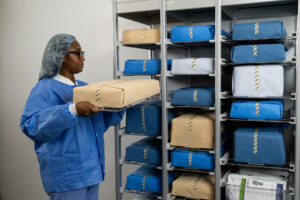
 Instrument sets and loaner trays have grown heavier and more angular, while the reflex has been to reach for heavier wrap to match. A tear or hole anywhere in the wrap compromises the sterile barrier. When that happens, the set is reprocessed, a loaner set may be unavailable, and a procedure waits.
This creates a very real demand for durability in wrap technology, but also leads departments to the question: how should they even judge durability? Because the usual proxy of wrap-weight is inaccurate and measures the wrong thing.
The reflex answer, and its hidden costs
The common response to a demanding tray is mass: a higher basis weight, a second layer, corner guards and other accessories added to compensate. Mass does add durability. It also adds bulk, handling strain across a shift, slower drying, and cost, since the accessories that promise protection are paid for on every tray they touch. A department can end up spending more to work around a heavy wrap than it spent on the wrap itself.
What strong enough actually means
There is a more objective measure than weight. Under EN 868-2, the European standard for sterilisation wrap, a wrap’s material is measured against defined performance requirements and tensile values, within the sterile barrier duty set by EN ISO 11607-1. The standard measures what the wrap does, which is to resist the forces that cause a breach and to maintain sterility to the point of use.
Strength and barrier, on the numbers
In testing recorded for ARMOR-FLEX*, grab tensile strength measured 95.2 lbf against 90.1 lbf for a conventional heavyweight wrap, and bacterial filtration efficiency measured 99.9% against 98.4%. The wrap is validated for both steam and low-temperature sterilisation.
Each figure describes one property under a defined test method: tensile speaks to breaking strength under pull, filtration efficiency to the share of bacteria the material holds back. They describe the material’s measured performance, not the outcome of any single pack in a department, which depends on load, handling and process as well. Their value is that they map to what the European standards ask a wrap to demonstrate: tensile performance and an effective microbial barrier. ARMOR-FLEX* reaches them through a lighter-weight hybrid construction rather than added grammage.
The cost of bulk the spec sheet does not show
Weight has consequences a strength figure does not capture. A bulkier pack is harder to drape into a clean, close fold, more tiring to handle, and slower to dry. Drying matters to the barrier in its own right, because a pack that reaches the store damp is treated as compromised. In the drying comparison recorded for ARMOR-FLEX*, the wrap was dry within 20 minutes, while a conventional heavyweight wrap still showed beading at 48 minutes.
Drying performance over time
Elapsed time 00:10
Elapsed time 20:00
Elapsed time 48:07
Illustration of tested drying performance. ARMOR-FLEX* with ASSURE-DRY* Technology absorbs and disperses moisture so the pack dries evenly, while the competitor wrap still showed beading at 48 minutes. A pack that reaches storage damp is treated as compromised under EN ISO 11607-1.
The question to take back to the department
The next wrap assessment turns on performance rather than weight: whether the wrap meets what the European standards define, and what that performance costs the department in bulk, handling and drying time. A lighter wrap that meets the standard protects the tray and spares the department the bulk and the accessories that heavier wrap invites.
Judge the wrap by what it is validated to do, and let the grammage fall where it may.
Interested in seeing how the HALYARD* ARMOR-FLEX* wrap with ASSURE-DRY* Technology performs against your own trays? Get in touch to discuss an evaluation with our team.
Discuss an evaluation


